When we look at images, we find those particularly aesthetically pleasing whose elements follow a specific ratio of lengths to areas. This principle of harmony is called the “Golden Ratio” and is widely used in nature.
One might think that in the age of graphics rendered by artificial intelligence, we no longer need the many fundamentals of graphic design. However, this is short-sighted, because on the one hand, we have to select the best option from the generated images. To make good decisions here, knowledge of proportions and aesthetics is essential. Furthermore, we must be able to clearly articulate our wishes in order to achieve an optimal result. Only things that we truly understand can we formulate clearly and unambiguously. Therefore, sound expertise is indispensable, especially when working with generative AI.
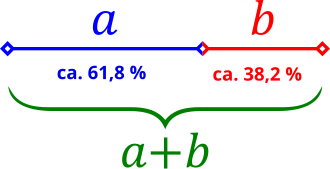
Geometrically, the Golden Ratio means that a line segment AB is divided into two segments of different lengths (a and b). If we now set a/b equal to the sum (a+b)/a, we obtain φ with the value 1.618. Incidentally, the exact value of φ is the square root of 5 (√5). The ratios of the lengths are approximately 3:2. The following graphic illustrates this relationship.
To apply the “Golden Ratio” to shapes, you don’t need to have passed advanced math courses in high school. All we need is the number φ. If we have a rectangle with a side length of one centimeter and multiply 1 by 1.618, we get 1.618. Now we can draw a rectangle with side lengths a = 1 and b = 1.618. The resulting ratio is perfect harmony and is called the “Golden Ratio.”
If we place our square with a side length of one centimeter inside this rectangle, we get a rectangular area B that can be divided according to the same pattern. If we repeat this process a few times, we get a tiled pattern. If we now draw an arc with a radius equal to the side length inside each of the resulting squares, we get a spiral. The shape in Figure 2 should already be familiar to most, and now you also know how it is created.
The spiral just described is also found in the so-called Fibonacci sequence. The Fibonacci sequence is a simple recursive addition of the two preceding numbers. Figure 3 shows how quickly the Fibonacci sequence can be calculated. As we can see, no advanced mathematical studies are necessary.
Where do we find the Golden Ratio used? Besides proportions in logos and other graphics, the Golden Ratio is often used in typography. The height ratios of small to large letters often follow a ratio of 1:1.618.
A typical scenario for applying the Golden Ratio is the positioning of objects within a graphic. To create a good illusion of depth, the objects need a corresponding ratio of heights to each other. But the way objects are positioned relative to each other also makes an image appear calm and harmonious or agitated and restless. So we have two ways of creating a mood in the viewer using the Golden Ratio. By deliberately disrupting the proportions, we achieve a certain restlessness, which can also be desirable. Such an inverted strategy can be used, for example, in advertising to stand out from the crowd and thus attract the viewer’s attention.
Nothing is as certain as change. This wisdom applies to virtually every area of our lives. The internet is also in a constant state of flux. However, the many changes in the technology sector are happening so rapidly that it’s almost impossible to keep up. Anyone who has based their business model on marketing through online channels is already familiar with the problem. Marketing will also continue to experience significant changes in the future, influenced by the availability of artificial intelligence.
Before we delve into the details in a little more detail, I would like to point out right away that by no means has everything become obsolete. Certainly, some agencies will not be able to continue to assert themselves in the future if they focus on traditional solutions. Therefore, it is also important for contractors to understand which marketing concepts can be implemented that will ultimately achieve their goals. Here, we believe that competence and creativity will not be replaced by AI. Nevertheless, successful agencies will not be able to avoid the targeted use of artificial intelligence. Let’s take a closer look at how internet user behavior has changed since the launch of ChatGPT around 2023. More and more people are accessing AI systems to obtain information. This naturally leads to a decline in traditional search engines like Google and others. Search engines per se are unlikely to disappear, as AI models also require an indexed database on which to operate. It’s more likely that people will no longer access search engines directly, but will instead have a personal AI assistant that evaluates all search queries for them. This also suggests that the number of freely available websites may decline significantly, as they will hardly be profitable due to a lack of visitors. What will replace them? Following current trends, it can be assumed that well-known and possibly new platforms such as Instagram, Facebook, and X will continue to gain market power. Short texts, graphics, and videos already dominate the internet. All of these facts already require a profound rethinking of marketing strategies.
They say dead live longer. Therefore, it would be wrong to completely neglect traditional websites and the associated SEO. Be aware of the business strategy you are pursuing with your internet/social media presence. As an agency, we specifically help our clients review and optimize existing strategies or develop entirely new ones. Questions are clarified as to whether you want to sell goods or services, or whether you want to be perceived as a center of expertise on a specific topic. Here, we follow the classic approach from search engine optimization, which is intended to generate qualified traffic. It is of little use to receive thousands of impressions when only a small fraction of them are interested in the topic. The previously defined marketing goals are promoted with cleverly distributed posts on websites and in social media. Of course, every marketing strategy stands or falls with the quality of the products or services offered. Once the customer feels they received a bad product or a service was too poor, a negative campaign can spread explosively. Therefore, it is highly desirable to receive honest reviews from real customers on various platforms. There are countless offers from dubious agencies that offer their clients the opportunity to generate a set number of followers, clicks, or reviews. The results quickly disappear once the service is no longer purchased. Besides, such generic posts created by bots are easy to spot, and many people now selectively ignore them. Thus, the effort is pointless. Furthermore, real reviews and comments are also an important tool for assessing the true external impact of your business. If you are constantly being told how great you are, you might be tempted to believe it. There are some stars who have experienced this firsthand.
Therefore, we rely on regular publications of high-quality content that are part of the marketing objective in order to generate attention. We try to use this attention to encourage user interaction, which in turn leads to greater visibility. Our AI models help us identify current trends in a timely manner so that we can incorporate them into our campaigns. Based on our experience, artificial intelligence allows us to create and schedule high-frequency publications for a relatively long campaign period. The time a post or comment goes live also influences success. There are isolated voices that suggest the end of agencies. The reasoning is often that many small business owners can now do all these great things that are part of marketing themselves thanks to AI. We don’t share this view. Many entrepreneurs simply don’t have the time to manage marketing independently across all channels. That’s why we rely on a healthy mix of manual work and automation in many steps. Because we believe that success doesn’t just happen in a test tube. We use our tools and experience to achieve qualitative individual results.
The desire of website operators to obtain as much information as possible about their users is as old as the internet itself. Simple counters for page views or the recognition of the web browser and screen resolution are the simplest applications of user tracking. Today, website operators are no longer solely dependent on Google to collect information about their visitors. There are sufficient free tools available to maintain their own tracking server. In this article, I will briefly discuss the historical background, technologies, and social aspects.
As more and more companies ventured into the vastness of the internet around the turn of the millennium, interest in finding out more about website visitors began. Initially, they were content with placing so-called visitor counters on the homepage. These visitor counters often displayed quite outrageous numbers. The ego of website operators certainly played a role, as many visitors to the homepage have an external impact and also make a certain impression on visitors. However, anyone who seriously wanted to make money through their website quickly realized that fictitious numbers didn’t generate revenue. So, more reliable methods were needed.
To prevent users from being counted multiple times each time they accessed the homepage, they began storing the IP address and setting a one-hour timeout before counting again. This was then called a reload block. Of course, this wasn’t a reliable detection method. At that time, connections over the telephone network were common via modem, and it often happened that the connection would drop, requiring a new connection. Then, a new IP address was also assigned. The accuracy of this solution therefore had a lot of potential for improvement.
When web space with PHP and MySQL databases became affordable around 2005, the trend shifted to storing visited pages in small text files called cookies in the browser. These analyses were already very informative and helped companies see which articles people were interested in. The only problem was when suspicious users deleted their cookies at every opportunity. Therefore, the trend shifted to storing all requests on the server, in so-called sessions. In most use cases, the accuracy achieved in this way is sufficient to better match supply to demand.
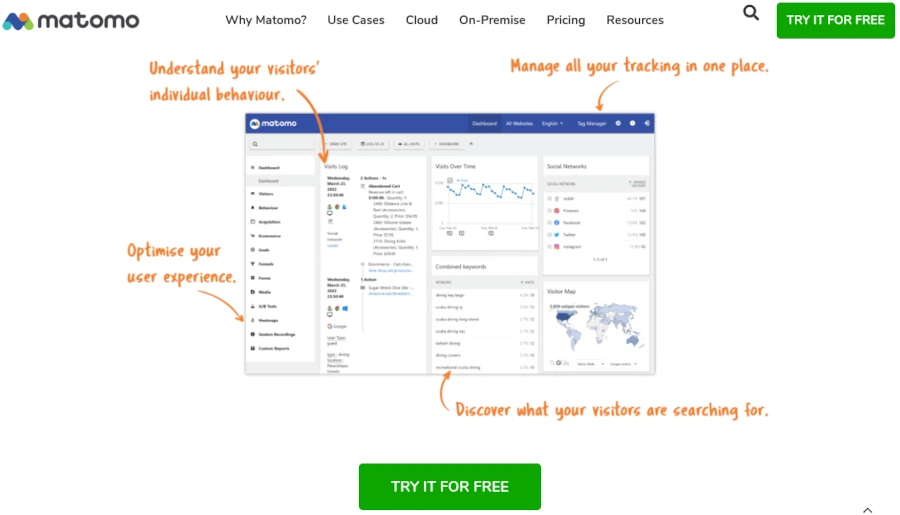
A popular tool for user tracking is Matomo, written in PHP. This self-hosted open source software allows you to bypass Google and also achieves better GDPR compliance, as the collected data is not shared with third parties. Furthermore, personalized data can be anonymized after a specified period of time, for example, at the beginning of the month. In this case, information such as IP addresses is replaced with random identifiers.
The whole issue is immediately taken to a whole new level when money is involved. In the past, it was companies that placed advertising banners on well-visited websites and then paid a small amount for every 1,000 ads. Nowadays, streaming services like Spotify or YouTube are interested in determining exactly how often a particular piece of content was viewed, or for how long a track was watched. Because the moment money is involved, there is a great interest in using small or large tricks to swindle a little more money than one is actually entitled to. This is precisely why companies like Google and Co. are constantly busy finding out how many users consume the content and for how long. In addition to tracking functions in the applications, these companies also use complex monitoring that can access original data from server logs and network traffic. This is where tools like the ELK stack or Prometheus and Grafana come into play.
Taking YouTube as an example, this service has several hurdles to overcome. Many people use YouTube as a TV replacement, as they can choose the content that interests them from a vast pool of content. A typical scenario is the automatic playback of ambient music for hours on end. If enough people do this without really paying attention to the content, it simply places a pointless burden on the server infrastructure and incurs considerable costs for the operator. This automatic autoplay function in the preview isn’t really interactive and is intended more as a teaser.
There are currently two strategies to keep users constantly engaged. One of these is short videos that run in a continuous loop until they manually move on to the next one. This allows you to mix in short advertising videos, but also to include news or opinion pieces. Of course, user tracking has to remove the repetitions during a monetized short on a continuous loop. This naturally leads to adjustments to the impression display. Another strategy used very excessively with long videos is disproportionately long ad breaks at relatively short intervals. This forces users to actively click away these ads each time, thus demanding attention.
Now, there are topics where services like YouTube, but also X or Facebook, have an interest in influencing their users in a certain direction. This could be the formation of opinions on political issues or simply commercialism. Now, one might think it would be a common strategy to suppress the visibility of undesirable opinions by adjusting the view count of the posts downwards. However, this wouldn’t be beneficial, because people have already seen the post. Therefore, a different strategy is much more effective. In the first step, the channel or post would be exempt from monetization, so the operator receives no additional compensation. In the next step, the number of views is increased, so that the content creator believes they are reaching a broad audience and takes fewer measures to gain more visibility. Additionally, using DevOps methods like A/B testing, feature flags, and load balancers, content views can be directed to posts only those who explicitly search for them. This avoids suspicion of censorship and significantly reduces visibility. Of course, unwanted posts only appear in recommendations for people who have explicitly subscribed to channels.
In the Netflix production “The Social Dilemma,” it is also lamented that bubbles are forming in which people with specific interests gather. This is an effect of so-called recommender systems. These recommenders are algorithms from the field of artificial intelligence. They function quite statically via statistical evaluations. Existing content is classified into categories, and then it is examined which groups of people are interested in a particular category and with what weighting. Content is then displayed accordingly, in proportion to the interests from that category. The content collected in this way can, of course, easily be marked with additional labels such as “well-suited” or “unsuitable.” Depending on the meta tags, unwanted content can then be buried in the depths of the database.
For all these measures to be effective, it is necessary to collect as much information about users as possible. This brings us back to user tracking. Tracking has become so sophisticated that browser settings that regularly delete cookies or the basic use of incognito mode are completely ineffective.
The only way to free yourself from dependence on the major platform providers is to consciously decide to no longer provide them with content. One step in this direction would be to operate your own website with appropriate monitoring for user tracking. Extensive content such as video and audio can be outsourced to several unknown platforms and embedded into the website. In this case, you should not upload all content to a single platform such as Odysee or Rumble, but rather cleverly distribute the content across multiple platforms without duplicating them. Such measures bind visitors to your own website and not to the respective platform operators.
Those with a little more financial freedom can also resort to free software such as PeerTube and host their own video platform. There are a number of options available here, but they require a great deal of effort and technical know-how from the operators.
[EN] We use cookies to improve your experience on our site. By using our site, you consent to cookies.
[DE] Wir verwenden Cookies, um Ihre Erfahrungen auf unserer Website zu verbessern. Durch die Nutzung unserer Website stimmen Sie Cookies zu.
This website uses cookies
Websites store cookies to enhance functionality and personalise your experience. You can manage your preferences, but blocking some cookies may impact site performance and services.
Essential cookies enable basic functions and are necessary for the proper function of the website.
Name
Description
Duration
Cookie Preferences
This cookie is used to store the user's cookie consent preferences.
30 days
These cookies are needed for adding comments on this website.
Name
Description
Duration
comment_author
Used to track the user across multiple sessions.
Session
comment_author_email
Used to track the user across multiple sessions.
Session
comment_author_url
Used to track the user across multiple sessions.
Session
These cookies are used for managing login functionality on this website.
Name
Description
Duration
wordpress_logged_in
Used to store logged-in users.
Persistent
wordpress_sec
Used to track the user across multiple sessions.
15 days
wordpress_test_cookie
Used to determine if cookies are enabled.
Session
Statistics cookies collect information anonymously. This information helps us understand how visitors use our website.
Matomo is an open-source web analytics platform that provides detailed insights into website traffic and user behavior.