
Cookbook: Maven Source Code Samples
Reply
Our Git repository contains an extensive collection of various code examples for Apache Maven projects. Everything is clearly organized by topic.
Back to table of contents: Apache Maven Master Class
- Token Replacement
- Compiler Warnings
- Excecutable JAR Files
- Enforcments
- Unit & Integration Testing
- Multi Module Project (JAR / WAR)
- BOM – Bill Of Materials (Dependency Management)
- Running ANT Tasks
- License Header – Plugin
- OWASP
- Profiles
- Maven Wrapper
- Shade Ueber JAR (Plugin)
- Java API Documantation (JavaDoc)
- Java Sources & Test Case packaging into JARs
- Docker
- Assemblies
- Maven Reporting (site)
- Flatten a POM
- GPG Signer

Apache Maven Master Class
Apache Maven (Maven for short) was first released on March 30, 2002, as an Apache Top-Level Project under the free Apache 2.0 License. This license also allows free use by companies in a commercial environment without paying license fees.
The word Maven comes from Yiddish and means something like “collector of knowledge.”
Maven is a pure command-line program developed in the Java programming language. It belongs to the category of build tools and is primarily used in Java software development projects. In the official documentation, Maven describes itself as a project management tool, as its functions extend far beyond creating (compiling) binary executable artifacts from source code. Maven can be used to generate quality analyses of program code and API documentation, to name just a few of its diverse applications.
Benefits
- Access to all subscription articles
- Accessing the Maven Sample Git Repository
- Regular updates
- Email support
- Regular live video FAQs
- Video workshops
- Submit your own topic suggestions
- 30% discount on Maven training
Online Course (yearly subsciption / 365 days)
Maven Master Class
m 3.47 Milli-Bitcoin

Target groups
This online course is suitable for both beginners with no prior knowledge and experienced experts. Each lesson is self-contained and can be individually selected. Extensive supplementary material explains concepts and is supported by numerous references. This allows you to use the Apache Maven Master Class course as a reference. New content is continually being added to the course. If you choose to become an Apache Maven Master Class member, you will also have full access to exclusive content.

Developer
- Maven Basics
- Maven on the Command Line
- IDE Integration
- Archetypes: Creating Project Structures
- Test Integration (TDD & BDD) with Maven
- Test Containers with Maven
- Multi-Module Projects for Microservices

Build Manager / DevOps
- Release Management with Maven
- Deploy to Maven Central
- Sonatype Nexus Repository Manager
- Maven Docker Container
- Creating Docker Images with Maven
- Encrypted Passwords
- Process & Build Optimization

Quality Manager
- Maven Site – The Reporting Engine
- Determine and evaluate test coverage
- Static code analysis
- Review coding style specifications
References & Literature
Index & Abbreviations
[A]
[B]
[C]
[D]
[E]
[F]
[G]
[H]
[I]
[J]
[K]
[L]
[M]
[N]
[O]
[P]
[Q]
[R]
[S]
[T]
[U]
[V]
[W]
[Y]
[Z]
[X]
return to the table of content: Apache Maven Master Class
A
- agiles Manifest
- (Apache) Ant
- Archetypen (archetypes)
B
C
D
- Deploy
- Docker Maven Image
- DRY – Don’t repeat yourself [2]
- DSL – Domain Specific Language
E
- EAR – Enterprise Archive
- EJB – Enterprise Java Beans
- Enforcer Plugin
- EoL – End of Live
F
G
- GAV Parameter [2]
- Goal [2]
- GPG – GNU Privacy Guard
H
I
- IDE – Integrierte Entwicklungsumgebung
- Installation (Linux / Windows)
- inkrementelle Builds
- (Apache) Ivy
J
- JAR – Java Archive
- jarsigner Plugin
- JDK – Java Development Kit
K
- Keytool (Java)
- KISS – Keep it simple, stupid.
- Kochbuch: Maven Codebeispiele
L
M
N
O
- OWASP – Open Web Application Security Project [2]
P
- Plugin
- Production Candidate
- POM – Project Object Model
- Maven Properties
- Prozess
Q
R
S
T
- target – Verzeichnis
- Token Replacement
U
V
W
- WAR – Web Archive
X
Y
Z
[A]
[B]
[C]
[D]
[E]
[F]
[G]
[H]
[I]
[J]
[K]
[L]
[M]
[N]
[O]
[P]
[Q]
[R]
[S]
[T]
[U]
[V]
[W]
[Y]
[Z]
[X]
return to the table of content: Apache Maven Master Class
Vibe coding – a new plague of the internet?
When I first read the term vibe coding, I first thought of headphones, chill music and transitioning into flow. The absolute state of creativity that programmers chase. A rush of productivity. But no, it became clear to me quite quickly that it was about something else.
Vibe coding is the name given to what you enter into an AI via the prompt in order to get a usable program. The output of the Large Language Model (LLM) is not yet the executable program, but rather just the corresponding source text in the programming language that the Vibe Coder specifies. Therefore, depending on which platform it is on, the Vibe Coder still needs the ability to make the whole thing work.
Since I’ve been active in IT, the salespeople’s dream has been there: You no longer need programmers to develop applications for customers. So far, all approaches of this kind have been less than successful, because no matter what you did, there was no solution that worked completely without programmers. A lot has changed since the general availability of AI systems and it is only a matter of time before LLM systems such as Copilot etc. also deliver executable applications.
The possibilities that Vibe Coding opens up are quite remarkable if you know what you are doing. Straight from Goethe’s sorcerer’s apprentice, who was no longer able to master the spirits he summoned. Are programmers now becoming obsolete? In the foreseeable future, I don’t think the programming profession will die out. But a lot will change and the requirements will be very high.
I can definitely say that I am open to AI assistance in programming. However, my experiences so far have taught me to be very careful about what the LLMs suggest as a solution. Maybe it’s because my questions were very specific and for specific cases. The answers were occasionally a pointer in a possible direction that turned out to be successful. But without your own specialist knowledge and experience, all of the AI’s answers would not have been usable. Justifications or explanations should also be treated with caution in this context.
There are now various offers that want to teach people how to use artificial intelligence. So in plain language, how to formulate a functioning prompt. I think such offers are dubious, because the LLMs were developed to understand natural (human) language. So what should you learn to formulate complete and understandable sentences?
Anyone who creates an entire application using Vibe Coding must test it extensively. So click through the functions and see if everything works as it should. This can turn into a very annoying activity that becomes more annoying with each run.
The use of programs created by Vibe Coding is also unproblematic as long as they run locally on your own computer and are not freely accessible as a commercial Internet service. Because this is exactly where the danger lurks. The programs created by Vibe Coding are not sufficiently protected against hacker attacks, which is why they should only be operated in closed environments. I can also well imagine that in the future the use of programs that are Vibe Coded will be prohibited in security-critical environments such as authorities or banks. As soon as the first cyber attacks on company networks through Vibe coding programs become known, the bans are in place.
Besides the question of security for Vibe Coding applications, modifications and extensions will be extremely difficult to implement. This phenomenon is well-known in software development and occurs regularly with so-called legacy applications. As soon as you hear that something has grown organically over time, you’re already in the thick of it. A lack of structure and so-called technical debt cause a project to erode over time to such an extent that the impact of changes on the remaining functionality becomes very difficult to assess. It is therefore likely that there will be many migration projects in the future to convert AI-generated codebases back into clean structures. For this reason, Vibe Coding is particularly suitable for creating prototypes to test concepts.

There are now also complaints in open source projects that every now and then there are contributions that convert almost half of the code base and add faulty functions. Of course, common sense and the many standards established in software development help here. It’s not like we haven’t had experience with bad code commits in open source before. This gave rise to the dictatorship workflow for tools like Git, which was renamed Pull Request by the code hosting platform GitHub.
So how can you quickly identify bad code? My current prescription is to check test coverage for added code. No testing, no code merge. Of course, test cases can also be Vibe Coded or lack necessary assertions, which can now also be easily recognized automatically. In my many years in software development projects, I’ve experienced enough that no Vibe Coder can even come close to bringing beads of sweat to my forehead.
My conclusion on the subject of Vibe Coding is: In the future, there will be a shortage of capable programmers who will be able to fix tons of bad production code. So it’s not a dying profession in the foreseeable future. On the other hand, a few clever people will definitely script together a few powerful isolated solutions for their own business with simple IT knowledge that will lead to competitive advantages. As we experience this transformation, the Internet will continue to become cluttered and the gems Weizenbaum once spoke of will become harder to find.



The Golden Ratio
When we look at images, we find those particularly aesthetically pleasing whose elements follow a specific ratio of lengths to areas. This principle of harmony is called the “Golden Ratio” and is widely used in nature.
One might think that in the age of graphics rendered by artificial intelligence, we no longer need the many fundamentals of graphic design. However, this is short-sighted, because on the one hand, we have to select the best option from the generated images. To make good decisions here, knowledge of proportions and aesthetics is essential. Furthermore, we must be able to clearly articulate our wishes in order to achieve an optimal result. Only things that we truly understand can we formulate clearly and unambiguously. Therefore, sound expertise is indispensable, especially when working with generative AI.
Geometrically, the Golden Ratio means that a line segment AB is divided into two segments of different lengths (a and b). If we now set a/b equal to the sum (a+b)/a, we obtain φ with the value 1.618. Incidentally, the exact value of φ is the square root of 5 (√5). The ratios of the lengths are approximately 3:2. The following graphic illustrates this relationship.
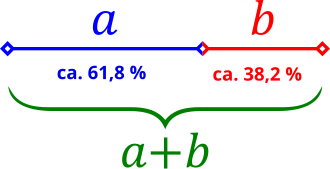
To apply the “Golden Ratio” to shapes, you don’t need to have passed advanced math courses in high school. All we need is the number φ. If we have a rectangle with a side length of one centimeter and multiply 1 by 1.618, we get 1.618. Now we can draw a rectangle with side lengths a = 1 and b = 1.618. The resulting ratio is perfect harmony and is called the “Golden Ratio.”
If we place our square with a side length of one centimeter inside this rectangle, we get a rectangular area B that can be divided according to the same pattern. If we repeat this process a few times, we get a tiled pattern. If we now draw an arc with a radius equal to the side length inside each of the resulting squares, we get a spiral. The shape in Figure 2 should already be familiar to most, and now you also know how it is created.

The spiral just described is also found in the so-called Fibonacci sequence. The Fibonacci sequence is a simple recursive addition of the two preceding numbers. Figure 3 shows how quickly the Fibonacci sequence can be calculated. As we can see, no advanced mathematical studies are necessary.


Where do we find the Golden Ratio used? Besides proportions in logos and other graphics, the Golden Ratio is often used in typography. The height ratios of small to large letters often follow a ratio of 1:1.618.
A typical scenario for applying the Golden Ratio is the positioning of objects within a graphic. To create a good illusion of depth, the objects need a corresponding ratio of heights to each other. But the way objects are positioned relative to each other also makes an image appear calm and harmonious or agitated and restless. So we have two ways of creating a mood in the viewer using the Golden Ratio. By deliberately disrupting the proportions, we achieve a certain restlessness, which can also be desirable. Such an inverted strategy can be used, for example, in advertising to stand out from the crowd and thus attract the viewer’s attention.